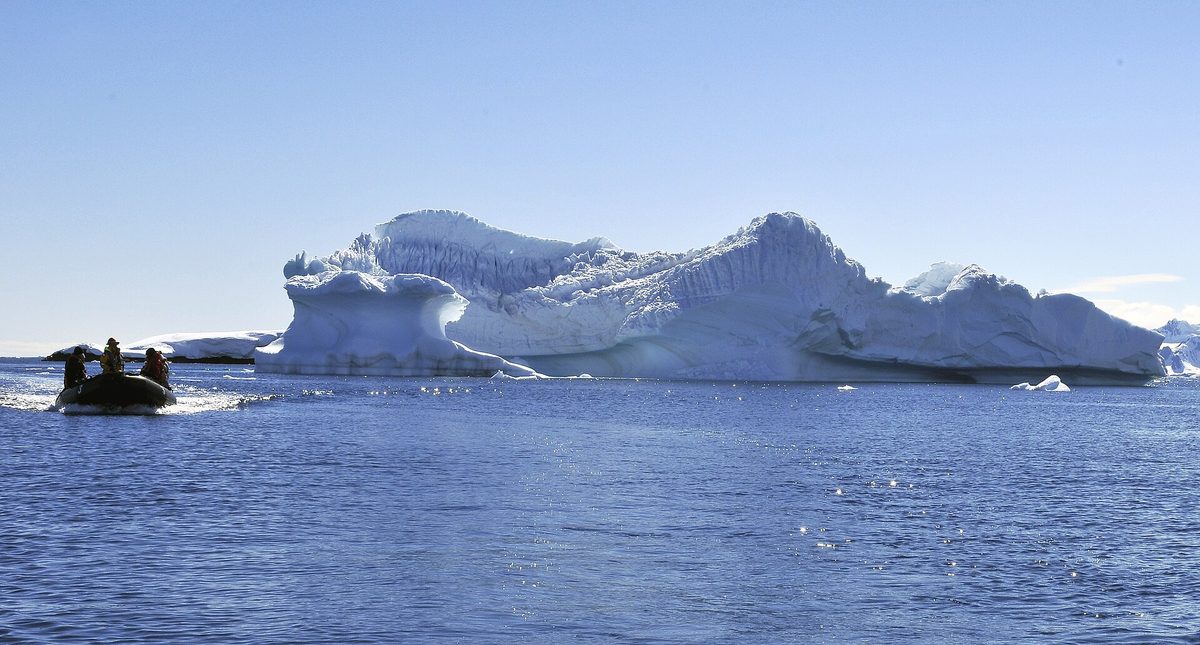
If you want to know what an antarctica itinerary day by day actually feels like from the inside — not as a list of ports but as a lived, hour-by-hour rhythm — then come with me through a representative morning at the bottom of the world. The PA crackles a little before seven. There is a half-second of static, then the unmistakable voice of the expedition leader, warm and faintly amused that we are all about to be woken so early: “Good morning, good morning, expeditioners. It is a glorious day in Antarctica.” Outside the porthole the light is already doing something theatrical to a wall of ice, and I lie there for exactly four seconds before the adrenaline wins and I am up, layering, half-laughing at myself, because this is the eighth time I have sailed south and it still gets me out of bed like a child on Christmas morning.
I have written this piece to be the diary you wish someone had handed you before your first voyage. There is a companion article that lays out the structure — the bones of the classic Antarctic Peninsula itinerary and which sites slot where. This one is different on purpose. This one is about texture: the boot room and the smell of neoprene, the queue for the gangway, the 6pm recap with a gin in hand, the loudspeaker that drags you out onto a frozen deck at 9:40 at night because someone has spotted blows on the horizon. If you only read one account of the daily rhythm before you go, I would like it to be this one.
The Shape of a Single Antarctic Day
Let me hold one ordinary day still and walk through it, because once you understand the shape of a single day you understand the whole trip. The structure repeats with beautiful, dependable regularity, and yet no two days are ever the same — the weather sees to that. Here is how a representative peninsula day tends to unfold once you are down in the ice.
The wake-up call lands somewhere between 6:45 and 7:15. It is never an alarm; it is always a human voice, and a good expedition leader uses it to set the emotional weather for the day. On a calm, blue morning they will be lyrical. On a grey, blowing morning they will be honest — “the wind has other ideas, but we have a plan” — which is its own kind of reassurance. They tell you the air temperature, the wind, what the captain can see, and roughly when the first outing will begin. Then the ship exhales and the corridors fill with the soft thunder of two hundred people deciding whether to shower before or after breakfast.
Breakfast is between roughly 7:15 and 8:15, and it is a strategic meal, not a leisurely one. You eat like someone who knows they are about to stand in a Zodiac in a stiff breeze for two hours: porridge, eggs, fruit, and far too much coffee. The dining room hums with that particular pre-landing energy — people half-dressed in base layers, binoculars already slung around necks, everyone glancing out the windows to see what the morning has dealt. Somewhere a naturalist is being interrogated over the toast about whether we’ll see leopard seals today, and the honest answer is always “Antarctica decides.”
A Real Antarctica Itinerary Day by Day
Before I take you site by site, let me give you the overview in one glance. What follows is a sample of a classic eleven-day voyage from Ushuaia, the kind that forms the backbone of most Antarctica cruises. Treat the table as an honest sketch rather than a contract — I cannot stress enough that the schedule below is the plan, and the plan flexes daily for weather, ice, and the simple fact that a pod of orcas does not consult the day sheet before surfacing beside the ship.
| Day | Location | Morning | Afternoon |
|---|---|---|---|
| 1 | Ushuaia, Argentina | Arrive, explore town | Embark, sail the Beagle Channel |
| 2 | Drake Passage | Sea legs, first lectures | Seabird watching, mandatory briefings |
| 3 | Drake Passage | More lectures, biosecurity check | First icebergs sighted, Zodiac briefing |
| 4 | South Shetland Islands | First landing among penguins | Half Moon Island chinstraps |
| 5 | Cuverville Island | Largest gentoo colony, Zodiac cruise | Danco Island walk to a summit |
| 6 | Neko Harbour / Paradise Bay | Continental landing at Neko | Paradise Bay Zodiac cruise |
| 7 | Lemaire Channel / Petermann | Sail the Lemaire at dawn | Petermann Island, optional polar plunge |
| 8 | Port Lockroy / Jougla Point | Historic base and post office | Optional camping ashore overnight |
| 9 | Drake Passage | Northbound, recap of the trip | Lectures, photo sharing, bird ID |
| 10 | Drake Passage | Final lectures, settle accounts | Captain’s farewell, packing |
| 11 | Ushuaia | Disembark after breakfast | Onward travel home |
That is the skeleton. Now let me put flesh on it, because the magic of this trip lives in the small moments the table can never hold — and in the daily ritual that frames every one of them.
The Morning Briefing and the Boot Room Ballet
At around 8:15 the PA chimes again and calls everyone to the lounge for the morning briefing. This is the operational heart of the day. The expedition leader stands at the front with a map and a marker and tells you the plan: where we are going, how the landing will be split (often a walking group and a Zodiac-cruising group that swap halfway), what the wildlife is doing, and — crucially — the rules of the site. They will say things like “stay five metres from the penguins, but if the penguins approach you, that is their right, so freeze and enjoy it.” They cover safety, the conditions, and the timing. By the end you know exactly which group you are in and roughly when your name will be called to the gangway. It is part theatre, part military operation, and entirely reassuring.
Then comes the boot room, which is its own small civilisation. Picture a low, warm room lined with cubbies, every surface festooned with damp waterproof trousers and the rubber muck boots the ship loans you for the week. There is a choreography to it that you learn fast: thermal layers, waterproof trousers, the big parka, then you sit on the bench and wrestle your feet into the tall boots while your neighbour does the same and you both pretend this is dignified. People help each other zip things. Someone always cannot find their left glove. The naturalists drift through checking that nobody is about to step into a Zodiac in trainers. If you want to get the layering right before you ever board, our guide to what to pack for Antarctica is the thing I’d read twice.
Biosecurity: The Vacuum Cleaner Ritual
Before that first landing — and at intervals throughout the voyage — you go through biosecurity, and I have come to love this ritual in a slightly nerdy way. Antarctica is one of the most pristine environments left on Earth, and the operators take their obligations under the international guidelines extremely seriously. So on one of the Drake days they lay out long tables and you bring every item that will go ashore: your parka, your camera bag, your trouser cuffs, your boots, your tripod, the velcro on everything. Then you vacuum it. You actually stand there with a handheld vacuum and a little brush, picking seeds and grit and stray fibres out of every seam and fold, because a single seed from a Patagonian hillside has no business colonising an Antarctic island.
Boots get the full treatment: every landing, you step through a tray of disinfectant on the way out and again on the way back in, scrubbing the soles so you carry nothing between sites. It sounds tedious written down. In practice it makes you feel like a custodian of the place rather than a tourist passing through, and that shift in attitude is, I think, one of the quiet gifts of the voyage. It is also a reminder that everything you do here — every step, every landing — is governed by a kind of collective care that the whole industry has agreed to uphold.
The Zodiac Queue and the First Splash of Cold
When your group is called, you head down to the gangway in your boots and life jacket. There is a queue, but it moves; this is where all that briefing pays off. At the bottom, two crew in a kind of sailor’s handshake — grip wrist to wrist — steady you as you step down into the Zodiac, the sturdy inflatable boat that is your workhorse for the entire trip. You shuffle along the pontoon to your spot, sit on the tube, and the moment the driver opens the throttle and the bow lifts, the cold air hits your face and you are grinning like an idiot. That first splash of spray, the first time you motor away from the warm hull of the ship toward a beach crawling with penguins, never stops feeling like a small miracle. The Zodiac is so central to the experience that it deserves its own paragraph in any honest account of things to do in Antarctica.
Two Outings a Day, and Lunch in Between
The fundamental unit of an Antarctic day is two outings — one mid-morning, one mid-afternoon — with lunch back aboard the ship in the gap. The morning outing tends to run roughly 9:00 to 11:30. You come back peeling off layers, faces wind-scoured and happy, and the ship has already repositioned or is repositioning while you eat. Lunch, around noon to one, is a glorious thing precisely because you have earned it: soup, something hot, salads, and the loud, overlapping talk of a hundred people comparing what they just saw. “Did you see the chick being fed?” “Did you see the skua take the egg?” The dining room after a good landing has the buzz of a school trip that went right.
The afternoon outing usually begins around 2:00 or 3:00, once the ship has nosed into the next bay. By now the rhythm is in your body. You know the boot-room dance, you know which gloves work, you know to bring fewer camera lenses than you think. The afternoon light in Antarctica, especially later in the season, turns long and golden and ridiculous, and many of the trip’s best photographs happen between three and five in the afternoon. Then, tired and salt-rimed, you climb back up the gangway for the part of the day I love nearly as much as the landings themselves.
The 6pm Recap, the Drink, and the Plan for Tomorrow
At six o’clock the PA calls everyone to the lounge for recap and briefing, and a steward is usually circulating with a tray of something — a glass of wine, a beer, a hot toddy if the day was raw. The expedition team takes turns at the front. The ornithologist explains the difference between the two albatross species you saw. The historian tells the story of the rusted whaling try-pots on the beach. The geologist holds up a chunk of rock and makes plate tectonics briefly thrilling. And then the expedition leader stands up, the room hushes, and they reveal the plan for tomorrow — which is always met with a kind of collective intake of breath, because tomorrow is a fresh unknown. The recap is part celebration, part lecture, part anticipation, and it knits the day together into a story.
Dinner follows around seven thirty, usually a proper sit-down affair with a menu, and by now you have found your people — the couple from Adelaide, the solo birder from Yorkshire, the family with the unflappable teenager who turns out to be the best wildlife spotter aboard. Conversation runs long. And then, just as you are thinking about bed, the PA might crackle one more time.
The Loudspeaker That Calls You On Deck for Whales
This is the moment that, more than any other, captures why an expedition voyage is unlike any other kind of travel. It is 9:40 at night. You are in your cabin, half-undressed, contemplating sleep. And the speaker comes alive: “Apologies for the late call — we have humpback whales feeding off the port bow. If you’d like to come up to the deck, now is the time.” There is a stampede. People throw parkas over pyjamas, grab the nearest beanie, and pour out onto the freezing deck in the silver not-quite-dark of the polar night. And there they are — the great glistening backs rolling up through the still water, the loud wet exhale of the blow hanging in the cold air, the fluke lifting and sliding under. Nobody speaks above a whisper. To understand just how much of this you might see, our overview of Antarctica wildlife is a good companion to keep on your phone.
Day 1: Arriving in Ushuaia, the End of the World
Now let me walk the whole arc. It begins in Ushuaia, the southernmost city on Earth, tucked under jagged peaks at the bottom of Argentina. I always try to arrive a day early, and I’d urge you to do the same — a delayed bag has ruined more than one person’s first landing. Ushuaia is a scrappy, charming frontier town with good steak, a surprising craft-beer scene, and a harbour bristling with the red and white hulls of expedition ships. Spend the spare day walking in Tierra del Fuego National Park or simply sitting on the waterfront watching the ships, letting it sink in that you are about to cross one of the wildest stretches of ocean on the planet. If you are still deciding how long to give the whole adventure, our piece on how many days you need in Antarctica is worth a read before you book your flights.
Day 1, Afternoon: Embarkation and the Beagle Channel
Embarkation is usually mid to late afternoon. You hand over your passport, find your cabin, fumble with the unfamiliar light switches, and then the ship throws its lines and slips out into the Beagle Channel — that long, mountain-flanked waterway named for Darwin’s vessel. This first evening is gentle and ceremonial. There is a mandatory safety drill, lifejackets and muster stations, the unglamorous but essential start to every voyage. Then a welcome from the captain and expedition leader, a first dinner, and a slow procession out on deck as Tierra del Fuego slides past in the dusk, cormorants on the channel markers, the last of the land before the open sea. Everyone is quietly electric. The crossing begins overnight.
Days 2 and 3: Crossing the Drake Passage
Ah, the Drake. The six-hundred-mile stretch of the Southern Ocean between South America and the peninsula has a fearsome reputation, and it deserves a measure of it — but I want to demystify it, because dread of the Drake puts some people off a trip they would adore. You get one of two versions: the “Drake Lake,” eerily calm and almost disappointing in its mildness, or the “Drake Shake,” a proper rolling sea that flattens the unprepared. Either way, give yourself the first morning to find your sea legs. Take the seasickness precautions seriously, eat dry crackers, stare at the horizon, and trust that by the afternoon of the first day most people have adjusted. I’ve devoted a whole guide to crossing the Drake Passage, and I genuinely think reading it in advance halves the anxiety.
The Drake days have their own rhythm, and it is one of the most underrated pleasures of the trip. These are lecture days. The expedition team — who are, to a person, some of the most interesting people you will ever share a ship with — deliver a rolling programme of talks: penguin biology, the heroic age of Shackleton and Scott, ice and glaciers, photography masterclasses, the politics of the Antarctic Treaty. You drift between the lounge, the bridge (most expedition ships have an open-bridge policy, and standing behind the officers as they con the ship through a grey swell is mesmerising), and the back deck, where the seabirds put on a show.
And what a show. The Drake is one of the great seabird theatres of the world. Wandering albatrosses, with their eleven-foot wingspans, ride the wind off the stern for hours without a single wingbeat. Petrels — pintado, southern giant, the lovely soft-grey light-mantled sooty — wheel and slice across the wave faces. I have stood at that rail for two hours in the cold, hypnotised, while the ship climbed and fell and the albatrosses simply hung there, masters of an element that was throwing us around like a toy. The biosecurity vacuuming and the Zodiac briefing also happen on these days, so by the time land appears you are fully prepared and fully indoctrinated into the culture of the ship.
Day 3, Afternoon: The First Iceberg
Somewhere late on the second Drake day, it happens. Someone on the bridge calls it, or the expedition leader’s voice comes over the PA with a different timbre, and everyone rushes to the windows: the first iceberg. After two days of nothing but grey water and grey sky, the appearance of that first impossible blue-white sculpture on the horizon is genuinely emotional. People go quiet, then start to laugh, then start taking far too many photographs of an object we will see ten thousand of over the coming week. It does not matter. The first one is the first one. Soon after, the dark smudge of the South Shetland Islands rises ahead, and you realise, with a jolt, that you have arrived in Antarctica.
Day 4: The South Shetlands and Your First Landing
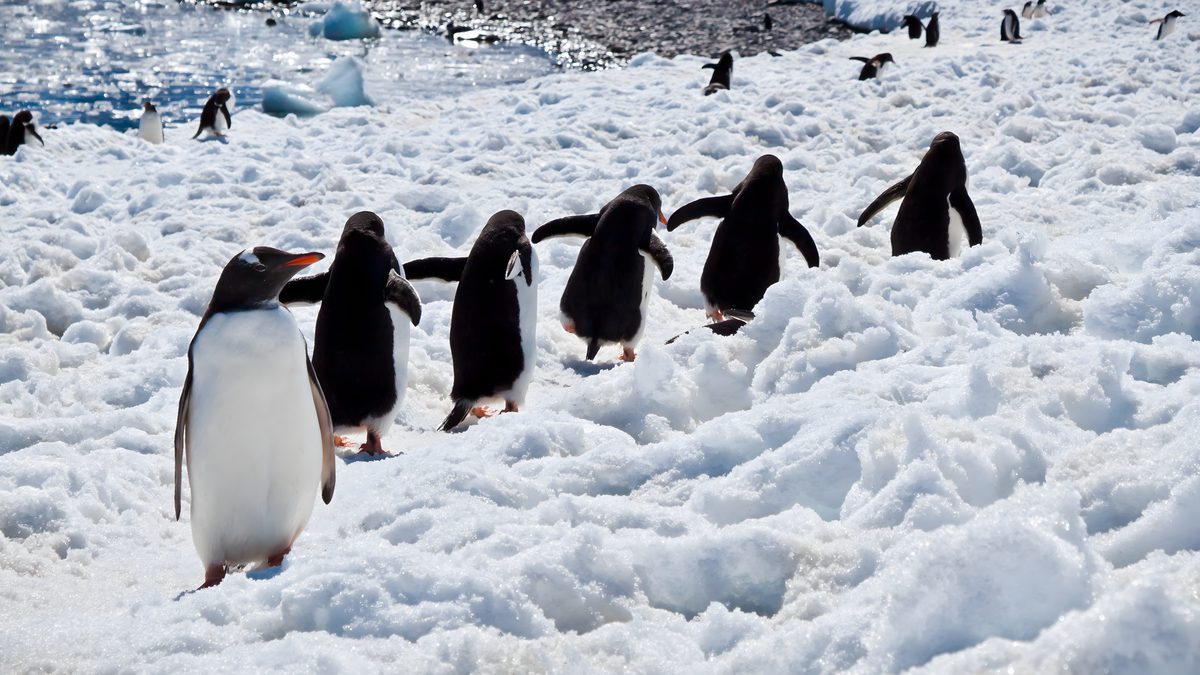
The first full day in the ice usually unfolds in the South Shetland Islands, the outer ring of the peninsula region, and it is deliberately a gentle introduction. Your first landing — the first time you actually step onto Antarctic shore — is a moment you will replay for years. You step off the Zodiac, the crew steady you, and suddenly you are standing on a black-sand or pebble beach surrounded by penguins who regard you with mild, comical indifference. The noise hits you first (a penguin colony is astonishingly loud), then the smell (let us be honest: it is pungent, a guano perfume you stop noticing within minutes), and then the sheer life of the place. You stand there, frozen in a permanent smile, and the week has truly begun.
Day 4, Afternoon: Half Moon Island and the Chinstraps
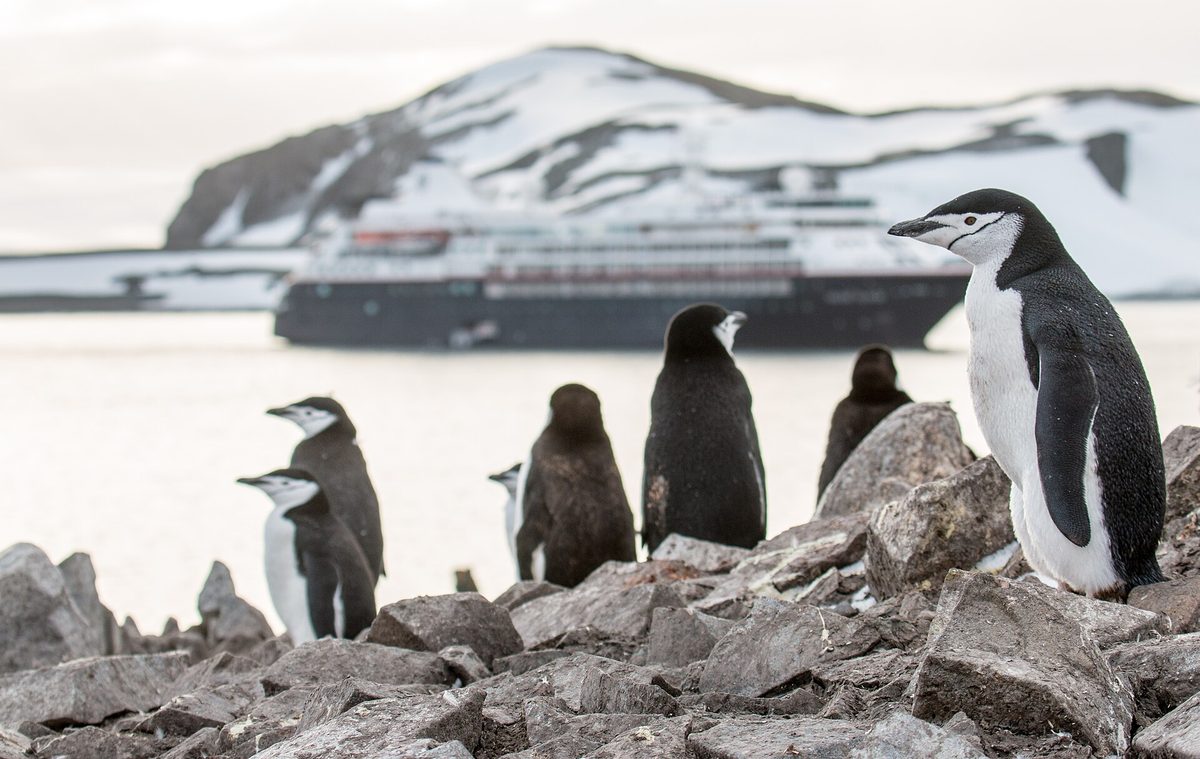
A classic afternoon stop here is Half Moon Island, a crescent of rock that is home to a boisterous colony of chinstrap penguins — named for the thin black line that runs under their chins, giving them the look of small, dapper soldiers in helmets. They nest among the rocks, commuting up improbable slopes on their little “penguin highways,” and the comedy of watching a chinstrap toboggan down a snow bank on its belly never gets old. There is usually a Wilson’s storm-petrel or two nesting in the scree, an Antarctic fur seal lounging where it shouldn’t be, and a view back across the bay to your waiting ship that makes you feel, briefly, like an explorer of the old school.
Day 5: Cuverville Island’s Gentoos and a Climb on Danco
Now we are properly into the peninsula, and the days get richer and richer. Cuverville Island holds one of the largest gentoo penguin colonies on the Antarctic Peninsula — thousands upon thousands of nesting pairs spread up the rocky slopes, a riot of squawking, stone-stealing, chick-feeding activity. Gentoos are my favourites, with their bright orange bills and the white bonnet patch over their eyes, and at Cuverville you can simply sit (the regulation distance away) and watch the soap opera of colony life for an hour. The Zodiac cruise around the island, threading between grounded icebergs sculpted into arches and caverns of impossible blue, is often the morning’s second act.
An afternoon landing nearby, often on Danco Island, frequently involves a climb — a switchback trudge up a snow slope to a summit with a view that justifies every aching calf muscle: the ship far below, the bay studded with bergs, mountains in every direction, and a gentoo colony at the top that has, for reasons known only to penguins, decided to nest as high as possible. The reward for the climb down is sometimes a glissade — a controlled slide on your backside down the slope you just laboured up, which reduces a group of dignified adults to shrieking children in about four seconds.
Day 6: Neko Harbour — Setting Foot on the Continent
This is, for many people, the emotional summit of the whole voyage: a continental landing. Many peninsula sites are technically islands, but Neko Harbour is one of the spots where you set foot on the Antarctic mainland itself — the seventh continent, under your own boots. Neko is a tight, glacier-rimmed bay, and the glacier at its head is active, which means that if you are lucky (and quiet) you will hear the crack like a rifle shot and watch a slab of ice the size of a house calve into the sea, sending a swell rolling across the bay. The guides position you carefully above the tide line for exactly this reason. There is a gentoo colony, a climb to a viewpoint, and the profound, slightly overwhelming awareness that you are standing on the loneliest continent on Earth.
Day 6, Afternoon: Paradise Bay, Rightly Named
The afternoon often brings Paradise Bay, and whoever named it was not exaggerating. On a still day the water turns to black glass, perfectly reflecting the mountains and the blue-veined icebergs, and the whole Zodiac cruise feels like gliding through a painting. This is mirror-calm, jaw-on-the-floor Antarctica — the postcard made real. You drift past a colony of blue-eyed shags nesting on a cliff, past a leopard seal hauled out on an ice floe regarding you with reptilian calm, past brash ice tinkling against the pontoons like a chandelier. Some voyages include a continental landing here too, at one of the old research stations. It is the kind of afternoon that ends with nobody saying anything at all, just the hum of the outboard and the click of shutters.
Day 7: The Lemaire Channel at Dawn
If the captain and the ice gods are willing, this is the morning you set an alarm even earlier than the wake-up call. The Lemaire Channel is a seven-mile passage barely a few hundred metres wide at its narrowest, flanked by sheer black cliffs that plunge straight into the sea and rise into cloud. It is so dramatic and so photogenic that it has earned the nickname “Kodak Gap.” Sailing it at dawn, in still air, with the water like mercury and the peaks catching the first pink light, is one of the great experiences in all of travel. The ship slows to a crawl. Nobody is in the dining room; everybody is on the bow, wrapped in everything they own, in near-total silence. Sometimes ice blocks the channel and the captain has to turn back — and that, too, is Antarctica reminding you who is in charge.
Day 7, Afternoon: Petermann Island and the Polar Plunge
South of the Lemaire, Petermann Island offers Adelie penguins — the classic tuxedoed penguin of the cartoons, here at one of their more northerly outposts — alongside more gentoos, and a historic cairn or two. But the afternoon at a sheltered anchorage is also when many ships offer the infamous polar plunge. Let me describe it honestly. You strip to your swimwear on the back deck in sub-zero air, a crew member loops a harness around you (the water is genuinely dangerous-cold), and you leap off the gangway into the Southern Ocean. The cold is not cold; it is a full-body electric shock, a clarifying, screaming, utterly unforgettable assault that lasts about four seconds before willing hands haul you out to a waiting towel and, usually, a shot of something warming. I have done it three times. I will do it again. It is gloriously stupid and you will never forget it.
Day 8: Port Lockroy, the Penguin Post Office
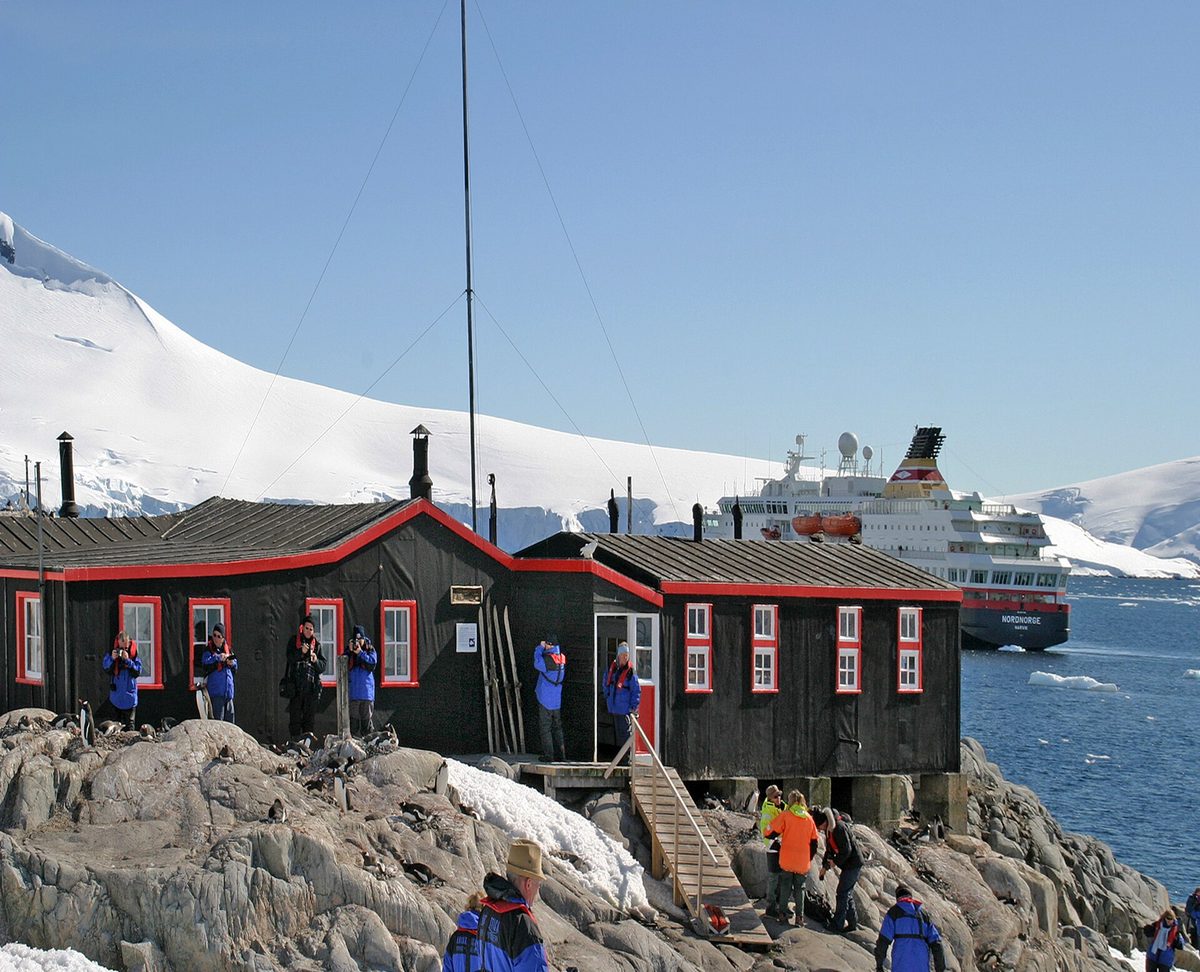
Port Lockroy is a small miracle and a firm favourite. It is a restored British base from the 1940s on tiny Goudier Island, now run as a living museum, a gift shop, and — wonderfully — the most remote functioning post office in the world, staffed each season by a handful of intrepid people who live there for months counting penguins and selling stamps. You can write a postcard, buy the stamp, and post it from Antarctica; it may take two or three months to reach home, carried out on the next ship, but the postmark is worth the wait. The base shares the island with a colony of gentoos who nest right up against the historic huts, entirely unbothered by the foot traffic, and a study has run for years comparing the penguins on the visited half of the island with the undisturbed half. A nearby landing at Jougla Point adds whale bones bleaching on the shingle and more shags. It is history, comedy, and wildlife in one perfect morning.
Day 8, Night: Camping on the Ice
On some voyages, this is the night you can choose to sleep ashore. Camping in Antarctica is not glamping — there are no tents with heaters and hot chocolate on tap. The standard offering is a bivvy bag and a sleeping mat dug into a shallow snow trench, no fires, no facilities, a strict leave-no-trace ethic, and a small group of you scattered across a snow slope under a sky that never fully darkens in the austral summer. It is cold, it is a little uncomfortable, and the silence — the vast, absolute, ringing silence of the continent, broken only by the distant crack of a glacier or the snore of your tent-mate — is something I have never experienced anywhere else on Earth. You wake stiff and frozen and grinning, and you Zodiac back to a hot breakfast feeling like you got away with something enormous.
Days 9 and 10: The Return Drake
And then, too soon, the ship turns north. The return crossing of the Drake has a different emotional flavour from the southbound one. The anxiety is gone; you are a salty veteran now. These days are for processing what you have seen. The lectures continue — often the more reflective ones, on conservation, on climate, on the history of the place — and there is a wonderful end-of-voyage tradition where guests and crew share their best photographs in a slideshow that reliably produces both gasps and tears. You settle your bar account, you swap email addresses with the people who were strangers two weeks ago, and the captain hosts a farewell. The sea may test you one last time, but you are ready for it now. There is also a quiet melancholy to the return Drake, the knowledge that you are sailing away from somewhere you may never see again — though, speaking from experience, almost everyone says “never again” and almost everyone comes back.
Day 11: Disembarkation in Ushuaia
The final morning is brisk and a little sad. You sail back up the Beagle Channel at dawn, the ship docks in Ushuaia, you have a last breakfast with your new friends, and then — far too quickly — you are wheeling your bag down the gangway and back into the ordinary world of taxis and airports and people who have no idea where you have been. My strong advice is to build a buffer day on the way home too; weather delays out of Ushuaia are common, and you do not want to miss an international connection. For the bigger picture of how this voyage compares to other options, our guides to Antarctica cruise routes explained and the full Antarctica cruise itineraries guide are the natural next reads.
Why the Schedule Always Flexes
I have given you specific sites and a specific order, and I want to be very clear about something: treat all of it as indicative, not guaranteed. The single most important thing to understand about an Antarctic itinerary is that it is written in pencil, not ink. The captain and expedition leader rebuild the plan every single day — sometimes twice a day — based on wind, sea state, ice conditions, and where the wildlife actually is. A planned landing at the Lemaire might become a different channel entirely because of pack ice. A calm forecast might collapse and turn a landing into a Zodiac cruise. This is not a flaw in the experience; it is the experience. You are not on a cruise that visits Antarctica. You are on an expedition that responds to Antarctica, and that responsiveness — that humility before a place far bigger than us — is exactly what makes it the trip of a lifetime. Here is a quick summary of the things most likely to shuffle your days:
- Wind: The biggest single factor. Above roughly 25 knots, Zodiac operations become difficult and a landing may be swapped, shortened, or cancelled.
- Sea ice and pack ice: A channel or bay that was open last week may be jammed shut, forcing a reroute to an alternative just as spectacular.
- Wildlife: A pod of orcas or a raft of feeding humpbacks will stop the ship in its tracks — happily so.
- Other ships: Operators coordinate so that only one vessel visits a site at a time, which occasionally reshuffles the order of the day.
- Swell and surge: Even on a calm day, a landing beach with too much surge is unsafe to step onto, and the team will pivot.
The Daily Rhythm in One List
If you take nothing else from this diary, take the shape of the day, because it is the thing nobody quite explains in advance. Here is the rhythm distilled:
- ~6:45–7:15 — Wake-up call over the PA from the expedition leader, with the day’s conditions and plan.
- ~7:15–8:15 — Breakfast, strategic and hearty, with one eye on the weather out the window.
- ~8:15 — Morning briefing in the lounge: the plan, the groups, the rules of the site.
- ~9:00–11:30 — First outing: a landing or a Zodiac cruise, sometimes both via group rotation.
- ~12:00–13:00 — Lunch aboard while the ship repositions to the afternoon site.
- ~14:00–17:00 — Second outing, often in the long golden afternoon light.
- ~18:00 — Recap and briefing with a drink: the day reviewed, tomorrow revealed.
- ~19:30 — Dinner, long and convivial, with your new shipmates.
- Anytime after — The whale call, the loudspeaker that may summon you on deck at any hour.
How This Voyage Fits Your Bigger Plans
The eleven-day classic peninsula voyage I have described is the most popular Antarctic trip for very good reason — it balances time, cost, and richness about as well as anything can. But it is not the only shape. If two Drake crossings sound like too much, an Antarctica fly-cruise itinerary lets you fly across the Drake to King George Island and join the ship there, trading the seabird theatre for two extra days in the ice. If you are very time-poor, there are options for a short Antarctica trip, though I would gently push you to give it as long as you possibly can. And the question of when to go matters as much as how long: our guide to the best time to visit Antarctica walks through how November ice, December chicks, and February whales each change the texture of the very days I have just described.
Frequently Asked Questions
How early does the wake-up call come each morning?
On a typical peninsula day, the expedition leader’s wake-up call comes over the ship’s PA somewhere between 6:45 and 7:15 in the morning, usually to give you enough time to eat a proper breakfast before the first outing of the day. It is always a human voice rather than an alarm, and it includes a quick weather and plan update. On lecture-only days crossing the Drake Passage, the wake-up is gentler and later, and on rare early mornings — sailing the Lemaire Channel at dawn, for instance — the team may wake you even earlier for something not to be missed.
How many times a day do you actually get off the ship?
The standard rhythm in the peninsula is two outings per day — one in the mid-morning and one in the mid-afternoon — with lunch back aboard the ship in between. An “outing” is either a shore landing or a Zodiac cruise, and on busier days a site may include both, with your group doing one while another group does the other and then swapping. Drake Passage crossing days have no outings at all, as you are at sea; those days are filled with lectures, seabird watching, and the all-important biosecurity preparation.
What is the boot room and biosecurity process actually like?
The boot room is a heated room lined with cubbies where you store and don your loaned rubber boots, waterproof trousers, and parka before each outing. Biosecurity is the ritual of keeping Antarctica pristine: before your first landing you vacuum every item going ashore — parka, bag, trouser cuffs, velcro, camera gear — to remove any seeds or fibres, and at every landing you scrub and disinfect your boots stepping on and off the ship. It feels meticulous because it is, and it is a requirement that every responsible operator takes extremely seriously.
What happens at the 6pm recap?
The daily recap and briefing at around six o’clock is a gathering in the ship’s lounge, usually with a drink in hand, where the expedition team reviews the day just past and reveals the plan for tomorrow. Team members give short, lively talks on the wildlife, history, or geology you encountered, and the expedition leader closes by outlining the next day’s intended sites and timings. It is equal parts social hour, mini-lecture, and the building of anticipation, and it is one of the most beloved fixtures of the daily rhythm.
Will the itinerary actually match the plan I was sent?
Almost certainly not exactly, and that is by design. An Antarctic itinerary is indicative, not fixed: the captain and expedition leader rebuild the plan daily around wind, ice, sea state, and wildlife. Named sites like Cuverville, Neko Harbour, or the Lemaire Channel are realistic targets, but any of them can be swapped for an equally spectacular alternative if conditions demand. Embracing this flexibility is essential — you are on an expedition that responds to Antarctica in real time, not a fixed-route cruise.
Do I have to do the polar plunge or the camping?
Not at all — both are entirely optional. The polar plunge, a brief harnessed leap into the Southern Ocean, is offered on most voyages at a sheltered anchorage, and plenty of guests happily watch from the deck with a hot drink instead. Camping ashore overnight, where offered, is also optional and often limited in numbers, sometimes carrying a small extra charge. Many travellers do neither and have a magnificent trip; others consider them the highlight. There is no pressure, and no judgement either way.
What is there to do during the two days crossing the Drake Passage?
Plenty, and the Drake days are more enjoyable than their reputation suggests. The expedition team runs a rolling programme of lectures on penguins, ice, history, photography, and the Antarctic Treaty; the bridge is usually open for you to watch the officers navigate; and the back deck offers world-class seabird watching, with albatrosses and petrels riding the ship’s wake for hours. These days are also when biosecurity preparation and the mandatory Zodiac briefing happen, so by the time the first iceberg appears you are fully ready to go ashore.
How fit do I need to be for the daily landings?
You need a reasonable, everyday level of fitness rather than anything athletic. The core requirements are the ability to climb up and down the gangway and step into and out of a moving Zodiac with crew assistance, and to walk and stand on uneven, sometimes snowy or rocky ground for an hour or two. Some optional walks involve a snow-slope climb, but these are always optional, and gentler alternatives or Zodiac cruises are offered. If you have specific mobility concerns, raise them with your operator in advance — many travellers well into their seventies and eighties do this trip beautifully.
Is the loudspeaker really going to wake me up for whales at night?
It genuinely might, and it is one of the joys of the voyage. Expedition ships use the PA to call guests on deck whenever something exceptional appears — feeding humpbacks, a pod of orcas, an extraordinary iceberg, or a spectacular sky. In the long twilight of the austral summer this can happen late in the evening, and a good expedition team will make the call even at 9:40 at night if the wildlife warrants it. You can, of course, sleep through it if you choose, but most people throw a parka over their pyjamas and run.
Final Thoughts
What stays with me, voyage after voyage, is not any single iceberg or penguin or whale. It is the rhythm — the dependable, comforting shape of the day that frames the wildest place on Earth and makes it knowable. The wake-up call. The boot-room ballet. Two outings and a lunch in between. The 6pm recap with a drink and a plan. The loudspeaker in the night. That rhythm is the secret architecture of an Antarctic expedition, the thing that turns chaos and weather and a thousand miles of ocean into the most coherent, most fully-lived eleven days you may ever spend. Read the structural guides, plan carefully, pack well — and then surrender to the rhythm and let the continent do the rest. You will come home changed, and you will, I promise, already be plotting how to go back.
Related Reading
- Antarctica cruise itineraries guide
- the classic Antarctic Peninsula itinerary
- Antarctica cruise routes explained
- how many days you need in Antarctica
- a short Antarctica trip
- an Antarctica fly-cruise itinerary
- Antarctica cruises
- crossing the Drake Passage
- Antarctica wildlife
- things to do in Antarctica
- what to pack for Antarctica
- the best time to visit Antarctica