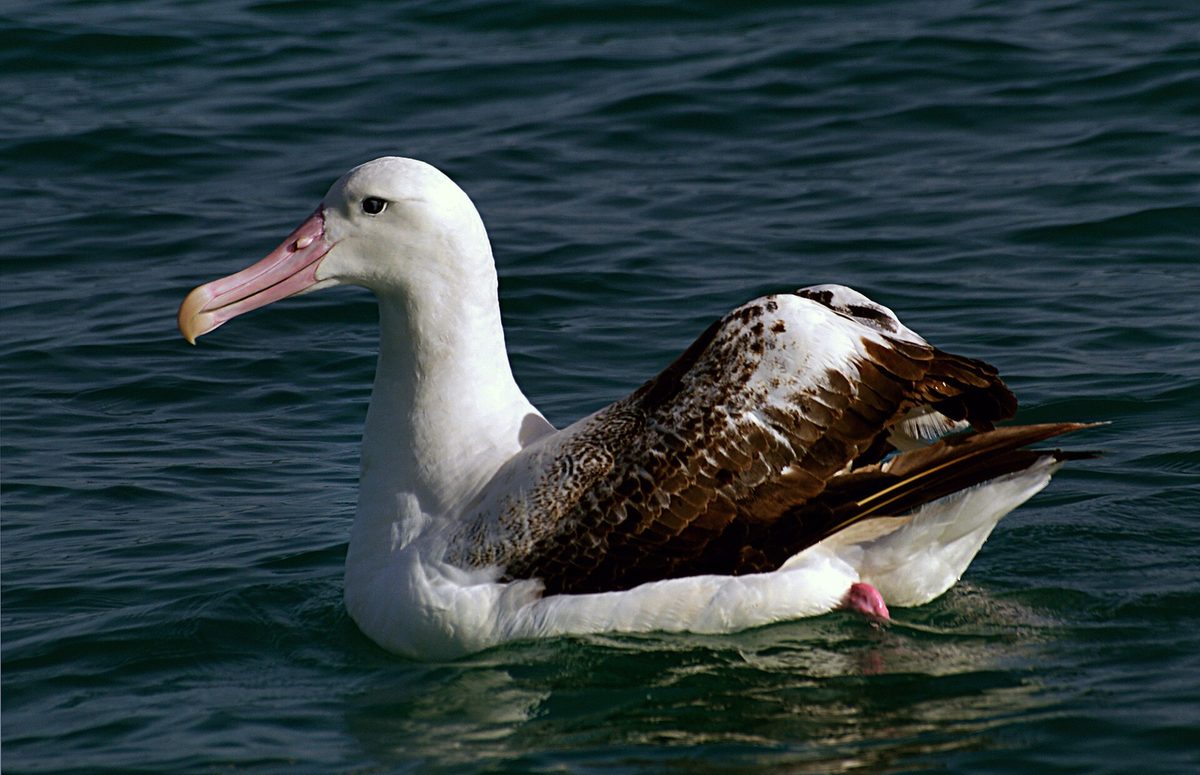
I still remember the first wandering albatross I saw from the stern of a ship in the Drake Passage — a bird with a wingspan wider than I am tall, hanging on the wind without a single beat, riding the wake as if the Southern Ocean had been built for it alone. That is the moment I tell people about when they ask why antarctica birdwatching is worth the long journey south. This is, quite simply, one of the great birding theatres on the planet: a place where you can watch seven species of penguin waddle across the ice, where giant petrels and prions wheel around the ship for days, and where the world’s largest flying bird drifts past at eye level. If you have ever kept a list, raised a pair of binoculars, or simply loved the sight of a seabird at sea, this is a continent that will rearrange your sense of what a birding trip can be.
I have sailed south many times, and I have shared the deck with all kinds of birders — obsessive listers chasing a clean sweep of albatrosses, gentle naturalists happy to watch a single chinstrap colony for an hour, photographers with lenses the size of drainpipes. This guide is everything I would tell a birding friend planning the trip: which species you can realistically expect, where to see them, when to go, how to choose a bird-friendly voyage or a dedicated leader-led tour, what optics to bring, how to make the most of the legendary Drake Passage seabirding, and the etiquette that keeps these astonishing birds safe. It is honest, too, about who this trip suits and who might find it slow going.
Why Antarctica is a bucket-list destination for birders
Most birding trips are about diversity — racking up hundreds of species in a rainforest or a wetland. Antarctica is different. The total species list is modest by tropical standards, but what it lacks in sheer numbers it makes up for in spectacle, accessibility, and sheer biomass. You are not pishing a skulking warbler out of a thicket here. You are standing in the open with a colony of a hundred thousand penguins stretching to the horizon, or watching tens of thousands of seabirds funnel past a headland. The birds are confiding, often absurdly so, because many have evolved with no land predators and simply do not register humans as a threat. For a birder used to working hard for every tick, the ease of it can be almost disorienting.
There is also the quality of the targets. This is the home of the albatrosses — the most charismatic seabirds on Earth — and of the tube-noses more broadly, the petrels and shearwaters and prions that spend their lives at sea and come to land only to breed. Add the penguins, the skuas, the sheathbills, the shags, and the terns, and you have a cast of birds that most birders only ever see in field guides. Many are range-restricted to the Southern Ocean and the sub-Antarctic islands, which means a voyage south is genuinely the only practical way to see them. To understand how this fits into a broader trip, our hub on planning Antarctica for every traveler compares trips by interest, and the wider Antarctica wildlife guide sets the scene for everything that breathes down here.
And then there is the setting. You are watching all of this against a backdrop of icebergs, glaciers, and mountains plunging straight into the sea. I have birded some of the great hotspots of the world, and nowhere combines the birds and the landscape quite like this. A snow petrel — pure white against black rock and blue ice — is one of the most beautiful sights in all of birding, and you cannot see it anywhere but here.
The penguins: seven species and where to find them
For most people, penguins are the headline act, and rightly so. Depending on your exact route you can realistically encounter around seven species across the Antarctic and sub-Antarctic, and watching them on land — courting, nest-building, feeding chicks, porpoising through the surf — is one of the great wildlife experiences anywhere. Our dedicated Antarctica penguins guide goes deep on behaviour and identification, but here is the birder’s-eye summary.
The Peninsula trio: gentoo, chinstrap, and Adelie
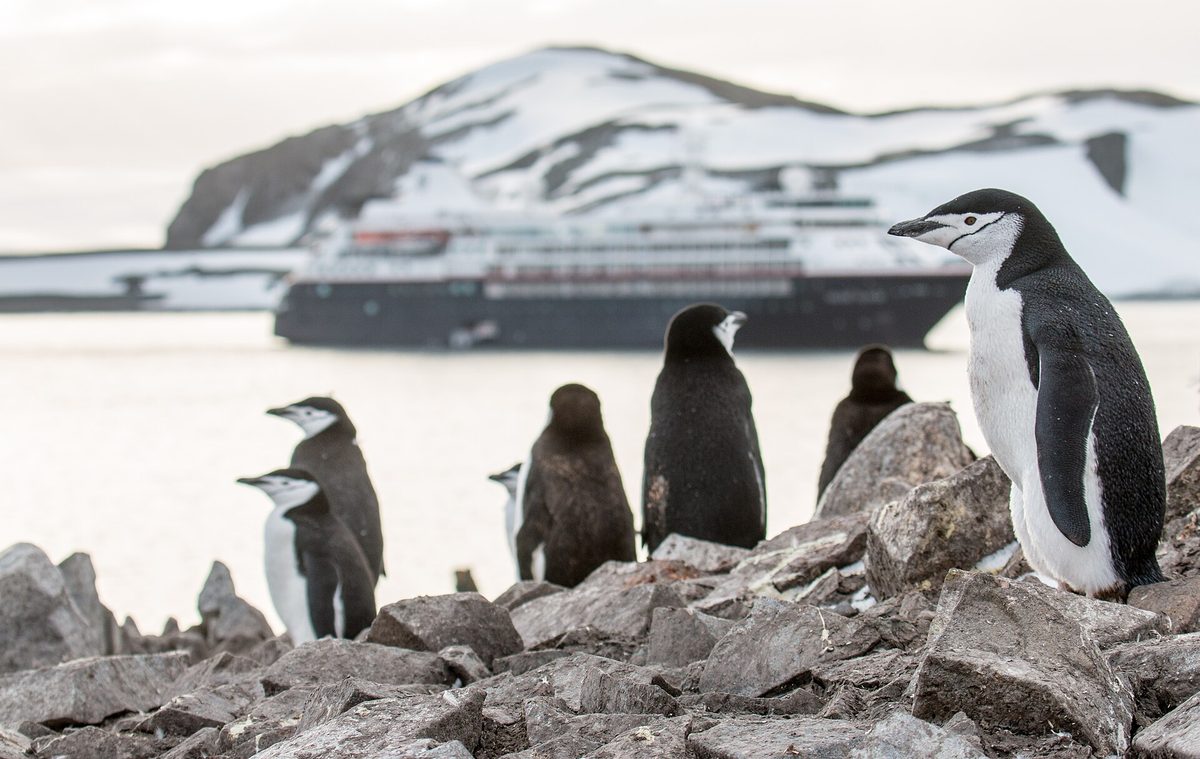
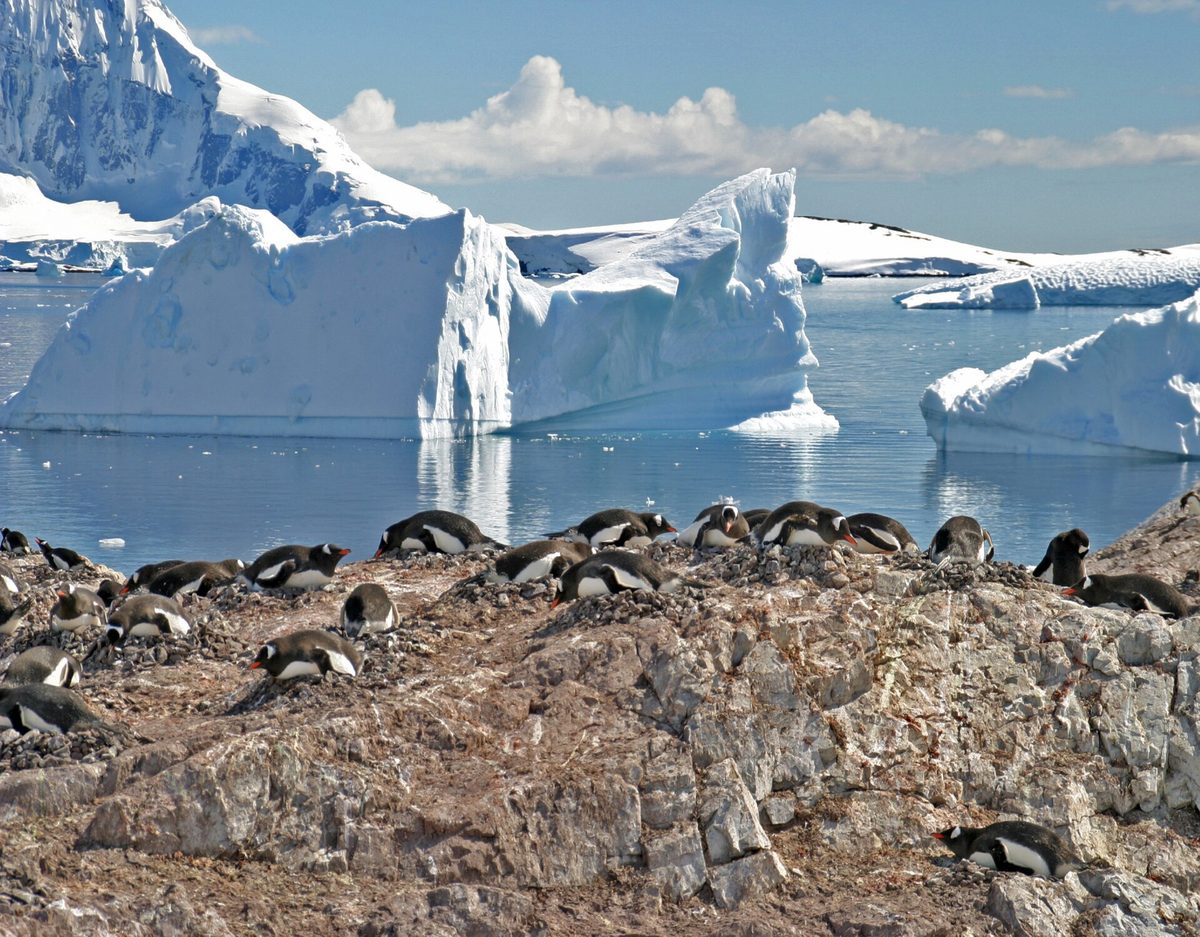
On a classic Antarctic Peninsula voyage, three penguin species dominate. Gentoos, with their bright orange bills and white head-patches, are the most widespread and adaptable, and you will see them at countless landings. Chinstraps — named for the thin black line under the chin — throng rocky islands in the South Shetlands; Half Moon Island is a classic spot. Adelies, the quintessential tuxedoed penguin with the white eye-ring, prefer colder, more ice-bound coasts and are a little less reliable on the standard Peninsula route, though good colonies exist. Seeing all three on one trip is very achievable.
The sub-Antarctic giants: king and macaroni
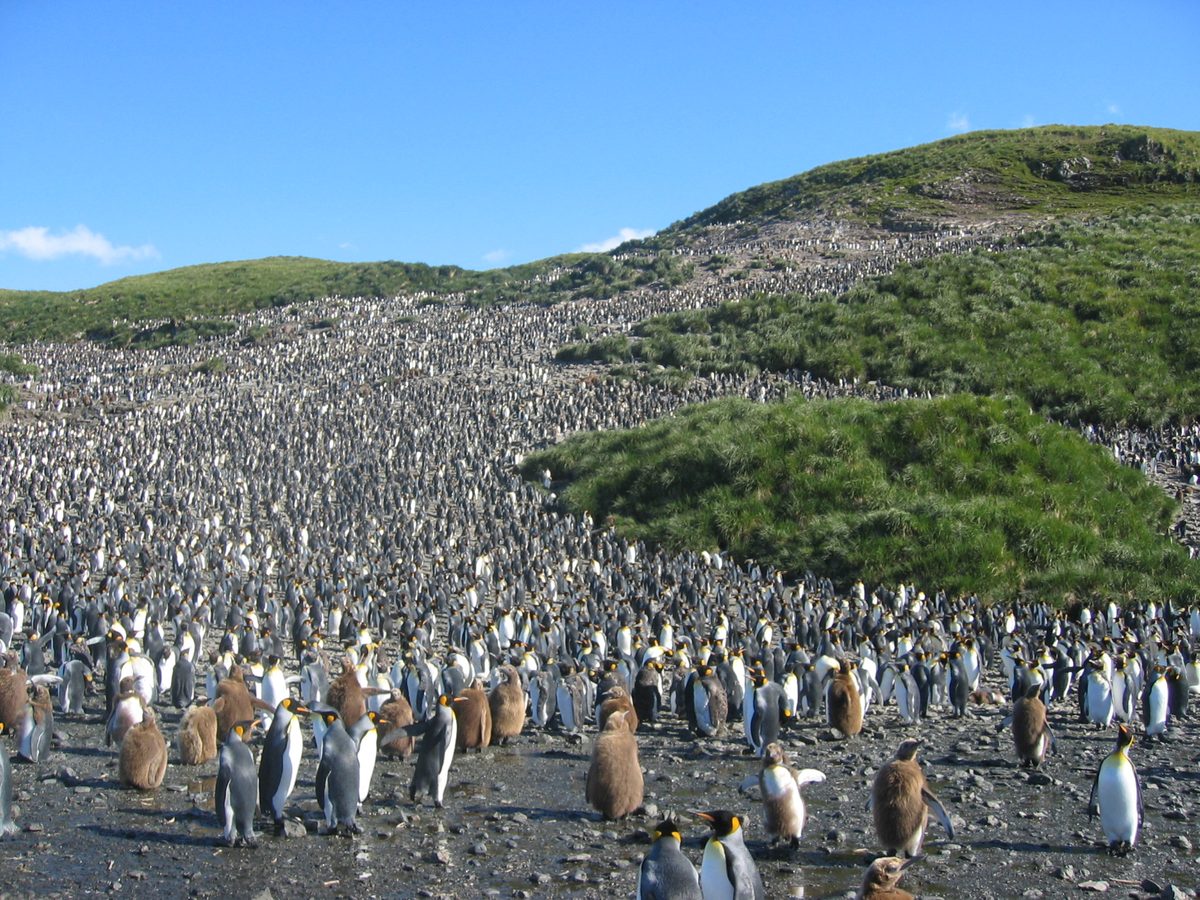
If you sail the longer route to South Georgia, you add the king penguin — second only to the emperor in size and, in my view, the most magnificent of them all. South Georgia’s king colonies number in the hundreds of thousands of pairs, and standing at the edge of one is a sensory overload of sound, smell, and movement that no photograph prepares you for. South Georgia also hosts macaroni penguins, the flamboyant crested species, though their colonies are often harder to reach. The rockhopper, another crested penguin, is more readily seen in the Falkland Islands.
The holy grail: the emperor penguin
Let me be honest about the emperor, because birders always ask. The emperor — the largest penguin, the one from the documentaries — breeds on fast ice in the deep south and is genuinely hard to reach. Standard Peninsula voyages do not usually encounter them. Seeing emperors reliably means a specialised, expensive trip: a fly-in expedition to a colony such as Snow Hill Island, often with helicopter support, or a deep Ross Sea or Weddell Sea voyage, all weather-dependent and far from guaranteed. If the emperor is your dream bird, plan a dedicated expedition rather than hoping one wanders past on a regular cruise. For how the regions differ, our Antarctica regions overview is the place to start.
| Penguin species | Where you are most likely to see it | Difficulty |
|---|---|---|
| Gentoo | Antarctic Peninsula & South Georgia — many landings | Easy |
| Chinstrap | South Shetland Islands (e.g. Half Moon Island) | Easy |
| Adelie | Colder Peninsula coasts & the far south | Moderate |
| King | South Georgia — vast colonies | Easy on a South Georgia voyage |
| Macaroni | South Georgia & sub-Antarctic islands | Harder — access varies |
| Rockhopper | Falkland Islands & sub-Antarctic | Easy in the Falklands |
| Emperor | Fast ice, deep south — specialist trips only | Hard — dedicated expedition |
The albatrosses: the real prize of antarctica birdwatching
If the penguins are the headline act, the albatrosses are, for serious birders, the main event — and this is the heading where I will say it plainly: the heart of antarctica birdwatching is time spent on deck watching these magnificent birds work the wind. There is nothing in the bird world quite like an albatross in flight. They are masters of dynamic soaring, extracting energy from the wind gradient over the waves so efficiently that they can travel thousands of miles barely flapping. Watching one bank low across a swell, tip a wingtip to the water, and rise again without effort is hypnotic. I have lost whole afternoons to it.
The wandering albatross
The wandering albatross is the species birders cross the world for. It has the largest wingspan of any living bird — commonly cited at up to around three and a half metres — and the first time you see one glide past the ship, the scale simply does not compute. South Georgia is the classic place to see them at their breeding grounds, where you can watch the great birds on the nest and displaying, but they range widely across the Southern Ocean and follow ships in the Drake.
The mollymawks and the sooties
Beyond the wanderer, the Southern Ocean offers a suite of smaller albatrosses. The black-browed albatross, with its dark eyebrow and stern expression, is the most frequently seen and breeds in huge numbers in the Falklands. The grey-headed albatross and the elegant light-mantled (sooty) albatross — the latter a smoky-grey beauty that nests on South Georgia’s cliffs and performs synchronised courtship flights — round out a list that any birder would treasure. On a good Drake crossing you might tally several albatross species in a single day, an experience that ruins you for ordinary seawatching forever.
Petrels, prions, and the rest of the seabird cast
The tube-noses do not end with the albatrosses. The Southern Ocean teems with petrels and their relatives, and learning to tell them apart on the wing is one of the great pleasures — and challenges — of birding down here.
The petrels worth crossing an ocean for
The snow petrel is, for many, the bird of the trip: a small, dazzlingly white petrel that flutters among the ice and is found nowhere else on Earth. The Antarctic petrel, boldly patterned in brown and white, is a true ice-edge specialist. The cape petrel — also called the pintado, meaning "painted" — is the cheerful checkerboard-backed bird that follows ships in flocks and is often the first seabird to win over non-birders on board. The southern giant petrel, a brute the size of a small albatross, patrols the colonies as both scavenger and predator. Add the smaller storm-petrels skittering over the surface, the diving petrels whirring past like feathered bumblebees, and the prions — small blue-grey petrels that move in fast, twisting flocks and are notoriously tricky to identify to species — and the seabirding rarely lets up.
Skuas, terns, shags, sheathbills, and more
Round out the list with the brown and south polar skuas (piratical gulls that harry other birds and raid penguin nests), the graceful Antarctic tern, the blue-eyed shags (cormorants with vivid eye-rings that breed alongside the penguins), and the snowy sheathbill — the only Antarctic bird without webbed feet, a scruffy white scavenger that struts around colonies cleaning up. In the Falklands and South Georgia you can add pipits, ducks, geese, caracaras, and a handful of passerines, which is why the longer routes produce by far the bigger trip lists.
Where to go: routes that maximise your bird list
The single biggest decision a birder makes is the route, because it dictates which species are even possible. Here is how I think about the main options, from the accessible classic to the epic.
The classic Antarctic Peninsula voyage
The bread-and-butter trip sails from Ushuaia, crosses the Drake Passage, and explores the Antarctic Peninsula and South Shetlands over roughly ten to twelve days. For birders this delivers the Peninsula penguin trio, a strong cast of petrels and skuas, blue-eyed shags, sheathbills, terns, and — crucially — two full days of Drake Passage seabirding each way, which is where many of the albatrosses and petrels are tallied. It is the best-value introduction and sees plenty of birds, even if it misses the sub-Antarctic specialities. Our guides to Antarctica cruises and Antarctica cruise itineraries break down the ships and the day-by-day structure.
The trifecta: Falklands, South Georgia, and the Peninsula
If you want the biggest possible bird list — and as a birder, you probably do — the long "trifecta" voyage is the one. Running roughly eighteen to twenty-three days, it adds the Falkland Islands (rockhopper penguins, black-browed albatross colonies, caracaras, and endemic passerines) and South Georgia (the king penguin spectacle, wandering and light-mantled albatrosses, macaroni penguins, and far more). South Georgia alone is, in my honest opinion, the single greatest seabird island on Earth, and the difference in your trip list between this route and the classic Peninsula trip is enormous. It costs more and demands more time, but for a dedicated birder it is worth every day. Our deep-dive on South Georgia Island explains why.
The far south and specialist emperor trips
For the truly committed, deeper voyages into the Weddell or Ross Seas, or dedicated fly-in trips to emperor colonies, open up the hardest targets — emperor penguins, Antarctic petrels at the ice edge, and a more remote feel. These are expensive, weather-dependent, and not for first-timers, but they are the only way to certain species. To see how it all maps out geographically, browse our Antarctica regions guide.
| Route | Typical length | What it adds for birders |
|---|---|---|
| Classic Peninsula | ~10–12 days | Peninsula penguins, Drake seabirding, petrels & skuas |
| Falklands – South Georgia – Peninsula | ~18–23 days | Kings, macaronis, rockhoppers, wandering & light-mantled albatross, passerines |
| Weddell / Ross Sea / emperor fly-in | Varies | Emperor penguin, ice-edge specialists, remote seabirds |
The Drake Passage: prime pelagic seabirding
Many travellers dread the Drake Passage. Birders, perversely, look forward to it. The notorious stretch of open ocean between Cape Horn and the South Shetlands is one of the world’s great pelagic seawatching arenas, and the two crossings (each typically around a day and a half to two days) often deliver the bulk of a trip’s tube-nose list. Albatrosses and petrels follow ships here, riding the wake and the updraft off the hull, which means you can study them at close range for hours rather than glimpsing a distant speck. Our full guide to the Drake Passage covers what the crossing is like overall; here is the birder’s version.
How to work the deck
The single best piece of advice I can give: spend time on deck, in all but the worst conditions. The birds come and go in waves, and the people who tally the most species are simply the ones who are out there when a new bird appears. Position yourself where you can see the wake and the windward side of the ship, dress for serious cold and wind-chill (more on gear below), and be patient. A good expedition will have an ornithologist or naturalist on board calling out birds and helping with identification — lean on them shamelessly. The "Drake Lake" days, when the sea is calm, are glorious for seabirding; even the "Drake Shake" days produce birds if you can keep your footing and your stomach.
Seasickness and seawatching
I will be candid: it is hard to enjoy seabirds while feeling wretched. If you are prone to motion sickness, sort your medication, patches, or wristbands before you sail, because the Drake can be rough. Some birders choose a fly-cruise that skips the crossing — but be aware that doing so trades away two of your best seabirding days, which for a birder is a real sacrifice. If the open-ocean birds are a priority, I would grit my teeth, take the tablets, and sail.
When is the best time to go birding in Antarctica?
The Antarctic travel season runs roughly from November to March, the austral summer, and for birders the timing genuinely matters because bird behaviour changes through the season. Our full best time to visit Antarctica guide covers the whole picture, but here is the birding-specific take.
November and early December: courtship and arrivals
Early season is for watching the breeding cycle begin. Penguins are courting, displaying, and building nests — you will see them carrying pebbles and squabbling over territory — and the snow is at its most pristine. Albatrosses are returning to their colonies. It is a wonderful time for behaviour, though chicks have not yet hatched.
Peak summer, December and January: the breeding crescendo
For most birders, the heart of the season is the sweet spot, and January in particular is excellent. Breeding activity peaks: penguin chicks hatch and grow, colonies are at their most frenetic, and the long daylight hours mean more time to watch and photograph. The weather is at its (relative) warmest and the wildlife is everywhere. If I had to pick one window for a first birding trip, it would be this one.
February and March: fledging, whales, and feeding flocks
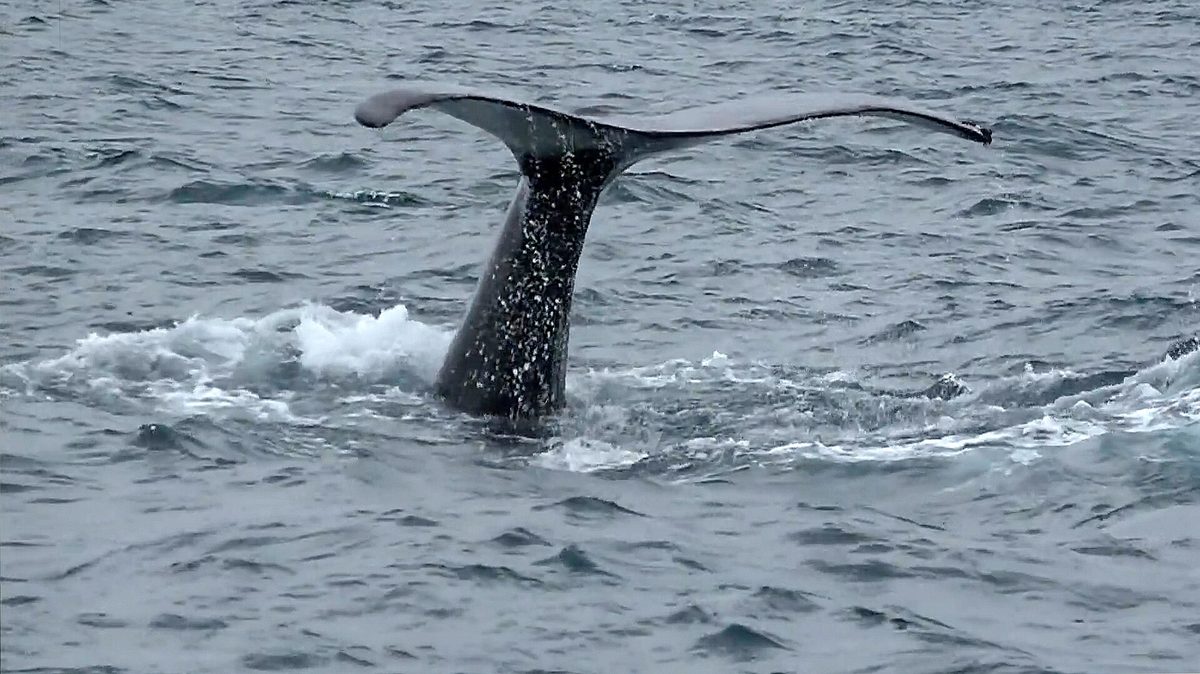
Late season brings fledging penguin chicks, hungry skuas and giant petrels capitalising on the colonies, and the best whale-watching of the year as humpbacks and minkes feed actively — a fine bonus for birders, and our Antarctica whales guide covers what to expect. Seabird numbers at sea remain strong. Colonies are messier and a little past their peak, but the wildlife action is excellent and late-season fares are often lower.
Choosing a birding-friendly voyage or a specialist tour
Not every Antarctic voyage is equally good for birders, and choosing the right one makes an enormous difference to your experience and your list. There are two broad paths.
A standard expedition with a strong natural-history team
Most reputable expedition operators carry an expedition team that includes an ornithologist or experienced naturalist, run regular birding lectures, and are happy to point their scopes at the wake on a Drake day. For many birders this is plenty: you get the birds, the landings, and expert help, alongside non-birding companions who are there for the scenery and the penguins. When you book, ask directly about the natural-history team, whether they have a dedicated birder on staff, and how much deck time the itinerary allows. A smaller ship is better — vessels carrying more than 500 passengers cannot land guests under the rules that govern Antarctic visits, and smaller ships mean more landings and a calmer deck for seawatching. Our Antarctica expedition ships rundown explains the differences.
A dedicated, leader-led birding tour
If you want the trip optimised around birds, look at the specialist birding tour operators that charter space on expedition ships and bring their own expert leaders. Companies such as Birdquest, Tropical Birding, Eagle-Eye Tours, and Birding Ecotours — I list these only as well-known examples, not endorsements, so compare carefully — run leader-guided departures where the whole focus is the birds: more time seawatching, expert identification of tricky prions and petrels, and an itinerary chosen to maximise the list. These tours cost more and attract a more single-minded crowd, but for a hardcore birder they are the gold standard. Always read the fine print and check exactly which ship and route the tour uses.
What to ask before you book
- Who is the bird expert? Is there a dedicated ornithologist or birding leader, and what are their credentials?
- How much deck and seawatching time? Itineraries vary; a birder wants generous open-ocean hours.
- Which route and ship? The route dictates the species; a smaller ship means more landings.
- Are scopes and a PA for bird calls available on deck? Good operators support seawatching actively.
- What is the group size ashore? Smaller landing groups mean less disturbance and better viewing.
Gear: optics and clothing for antarctica birdwatching
You can enjoy the birds with nothing but your eyes — the penguins are right there — but the right kit transforms the experience, especially for the seabirds. Here is what I bring and recommend.
Binoculars
Good binoculars are the single most important item. For Antarctica I favour a bright, waterproof 8×42 or 10×42 — 8x is easier to hold steady on a moving deck and gathers more light on grey days, while 10x reaches a little farther for distant seabirds. Whatever you choose, make sure they are properly waterproof and fog-proof, because spray, snow, and the constant move between cold outdoor air and warm indoor cabins will defeat lesser optics. Bring a rain guard and a good harness or strap.
A scope — useful but optional
A spotting scope can be wonderful at penguin colonies, on distant cliffs, and for studying albatrosses at South Georgia breeding grounds, but it is far less useful at sea, where the motion of the ship makes a tripod-mounted scope frustrating. If you are a hardcore birder heading to South Georgia, a scope earns its place ashore; if you are travelling light or doing only the Peninsula, you can usually manage without. Some birders bring a compact travel scope as a compromise.
Cameras and telephoto lenses
If you photograph birds, a telephoto lens is the tool of the trip — something in the 100–400mm or 150–600mm range covers most situations, from confiding penguins to distant albatrosses, while a shorter zoom captures colonies in their landscape. Image stabilisation helps enormously on a moving deck. For a full treatment of camera strategy, our Antarctica photography trip guide and the broader Antarctica photography resource are the places to go. Bring more memory cards and batteries than you think you need — cold drains batteries fast.
Clothing for long deck sessions
Seabirding means standing still in cold wind for hours, which is far colder than walking around ashore. Dress in serious layers: thermal base, insulating mid-layers, a windproof and waterproof shell, plus a warm hat, a buff or balaclava, and — critically — gloves you can actually operate binoculars in (I bring thin liner gloves under warmer mitts). Most operators lend or provide a parka and loan boots, but the layers underneath are yours to bring. Our what to pack for Antarctica guide and the detailed Antarctica packing list cover it all; do not underestimate how cold a two-hour stint at the rail can be.
Etiquette, IAATO rules, and biosecurity
Birding in a place this fragile comes with real responsibilities, and as a birder you should be a model visitor. Tour operators here follow the guidelines of the International Association of Antarctica Tour Operators (IAATO), and the rules exist to protect the very birds you came to see.
Keep your distance
There are minimum-approach distances for wildlife — commonly around five metres from most animals, more for some species and situations — and you must never approach, surround, or block the path of a bird, never get between a penguin and the sea or its nest, and always let the animals dictate the encounter. The good news is that the birds are so confiding that you rarely need to get close: sit still and quiet, and they will often come to you. A long lens or your binoculars do the reaching, not your feet.
Never disturb nests or colonies
Stay on the routes your guides indicate, keep to the edges of colonies, and never walk through a breeding group. Stressed birds may abandon eggs or chicks, and a careless visitor can leave skuas an open buffet. Keep noise down, move slowly, and follow your expedition team’s instructions to the letter — they know each site’s sensitivities.
Biosecurity and avian disease
Biosecurity is taken seriously, and recent concern about avian influenza in the region has made it more important than ever. Expect to scrub and disinfect your boots between landings, vacuum your outer clothing and bags before the first landing to remove seeds and soil, and avoid sitting or kneeling on the ground near colonies. Do not bring food ashore. These measures stop you spreading disease and invasive material between sites — an essential part of responsible Antarctica travel, and a duty every birder should embrace without complaint.
Practical planning for a birding trip south
The birds are the easy part. A smooth trip to a place this remote takes a little planning, so here is what I tell every birder heading down.
Book early and choose your route first
The best departures — especially the longer South Georgia trifecta voyages and specialist birding charters — sell out a year or more ahead, so decide your route based on your target species first, then book the right ship as early as you can. For how the journey works overall, our piece on Antarctica cruises is a solid starting point.
Build in a buffer and sort the essentials
Add at least one night in Ushuaia (or Punta Arenas for fly-cruises) before embarkation as insurance against flight delays — missing your departure is the one mistake you cannot recover from. Arrange comprehensive travel insurance that explicitly covers Antarctica and emergency medical evacuation, which many operators require. If you have any health or mobility concerns about getting in and out of Zodiacs and walking on uneven, snowy ground, check the Antarctica fitness requirements before you commit.
Prepare your list and your field skills
Bring a good Southern Ocean seabird guide and study it before you go — the prions and smaller petrels are genuinely difficult, and a little homework pays off enormously at the rail. Download or print a checklist for the region so you can keep your trip list as you go. And lean on the on-board experts: half the joy of antarctica birdwatching is learning to separate a slender-billed prion from an Antarctic prion with someone who has done it a thousand times.
Who an Antarctica birding trip suits — and who it doesn’t
I believe in honest advice, so here is the candid version of who should book this trip.
It is ideal for travellers who…
- Love seabirds and penguins and dream of albatrosses, petrels, and a king penguin colony.
- Enjoy quality and spectacle over a long species list — this is depth, not breadth.
- Are happy to spend hours on a cold deck watching the sea, and to be patient for the best birds.
- Are reasonably mobile and comfortable climbing in and out of Zodiacs on uneven ground.
- Value travelling responsibly and following strict wildlife and biosecurity rules.
It is probably not for travellers who…
- Measure a trip purely by the number of species ticked — the total list is modest by tropical standards.
- Dislike cold, wind, and motion at sea, and would be miserable on a rough Drake crossing.
- Want warm-weather comfort and have little interest in seabirds for their own sake.
- Are on a strict budget where the cost would cause real stress — this is an expensive trip.
If you are bringing a non-birding partner, take heart: Antarctica is so spectacular that even people who have never raised binoculars fall for the penguins and the scenery, which makes it one of the easiest birding trips to sell to a reluctant companion. Our hub on Antarctica for every traveler helps match the trip to mixed-interest groups.
Frequently asked questions
How many bird species can you see in Antarctica?
It depends heavily on your route. A classic Peninsula voyage typically yields a few dozen species — the three Peninsula penguins plus a strong cast of albatrosses, petrels, prions, skuas, shags, terns, and a sheathbill. The longer Falklands–South Georgia trifecta can push a trip list considerably higher by adding king, macaroni, and rockhopper penguins, more albatrosses, caracaras, and several passerines. Antarctic birding is about quality and spectacle rather than a huge species count.
What penguin species can I see on an Antarctica birding trip?
On a standard Antarctic Peninsula trip you can expect gentoo, chinstrap, and Adelie penguins. Add South Georgia and you gain king and macaroni penguins, and the Falklands add rockhoppers, so a full trifecta voyage can deliver around six species. The emperor penguin is the exception — it breeds on remote fast ice and requires a specialised, expensive fly-in or deep-south expedition rather than a regular cruise.
Can you see the wandering albatross in Antarctica?
Yes — the wandering albatross, which has the largest wingspan of any living bird, ranges across the Southern Ocean and frequently follows ships in the Drake Passage, so you have a good chance of seeing one at sea on the way south. To see them at their breeding colonies, including birds on the nest and displaying, head for South Georgia, the classic place to encounter them up close.
When is the best time for birdwatching in Antarctica?
The season runs November to March. November and early December bring courtship and nest-building; the peak of December and January — January especially — offers hatching chicks, frenetic colonies, and long daylight, and is the sweet spot for most birders; February and March bring fledging chicks, active skuas and giant petrels, and excellent whale-watching. Seabirding at sea is good throughout the season.
What binoculars should I bring to Antarctica?
A bright, fully waterproof and fog-proof 8×42 or 10×42 is ideal. The 8x is easier to hold steady on a moving deck and performs better in low light, while the 10x reaches a little farther for distant seabirds. A spotting scope is useful ashore at colonies and on South Georgia but frustrating at sea, and a telephoto camera lens in the 100–400mm or 150–600mm range is the tool of choice if you photograph birds.
Do I need a specialist birding tour, or is a regular cruise enough?
A regular expedition cruise with a strong natural-history team is plenty for many birders — most reputable operators carry an ornithologist or naturalist and support seawatching from the deck. If you want the trip optimised entirely around birds, with expert leaders, maximum deck time, and tricky identifications handled for you, a dedicated leader-led birding tour from a specialist operator is the gold standard, though it costs more and attracts a more single-minded crowd.
Is the Drake Passage good for seabirding?
Excellent — it is one of the world’s great pelagic seawatching arenas. Albatrosses and petrels follow ships across the Drake, riding the wake and the updraft off the hull, so you can study them at close range for hours. The two crossings often deliver the bulk of a trip’s tube-nose list, which is why birders, unlike most travellers, genuinely look forward to the Drake. Spend as much time on deck as conditions allow.
Are there rules about approaching birds in Antarctica?
Yes. Operators follow IAATO guidelines with minimum-approach distances — commonly around five metres from most wildlife, more in some cases — and you must never block a penguin’s path to the sea or its nest, never walk through a colony, and always let the birds dictate the encounter. Strict biosecurity, including boot disinfection and clothing checks, is required to prevent spreading avian disease such as bird flu and invasive material between sites.
Can I see emperor penguins on a normal Antarctica cruise?
Usually not. Emperor penguins breed on remote fast ice deep in the south and are rarely encountered on standard Peninsula voyages. Seeing them reliably means a specialised, expensive expedition — a fly-in trip to a colony such as Snow Hill Island, often with helicopter support, or a deep Weddell or Ross Sea voyage — all weather-dependent and far from guaranteed. If the emperor is your dream bird, plan a dedicated trip around it.
Final thoughts
I have raised my binoculars in a lot of places, but nowhere has rearranged my idea of what birding can be quite like the Southern Ocean. The penguins that ignore you, the petrels that wheel for days, the albatross that hangs on the wind as if gravity were optional — this is birdwatching stripped back to pure wonder, set against the most beautiful backdrop on the planet. That is what antarctica birdwatching gives you: not a record-breaking species count, but a handful of birds so magnificent, so confiding, and so wedded to this wild place that you will carry them with you for the rest of your birding life. Pack your best binoculars, dress for the deck, choose a route that matches your dream birds, and go. The albatrosses are waiting.